

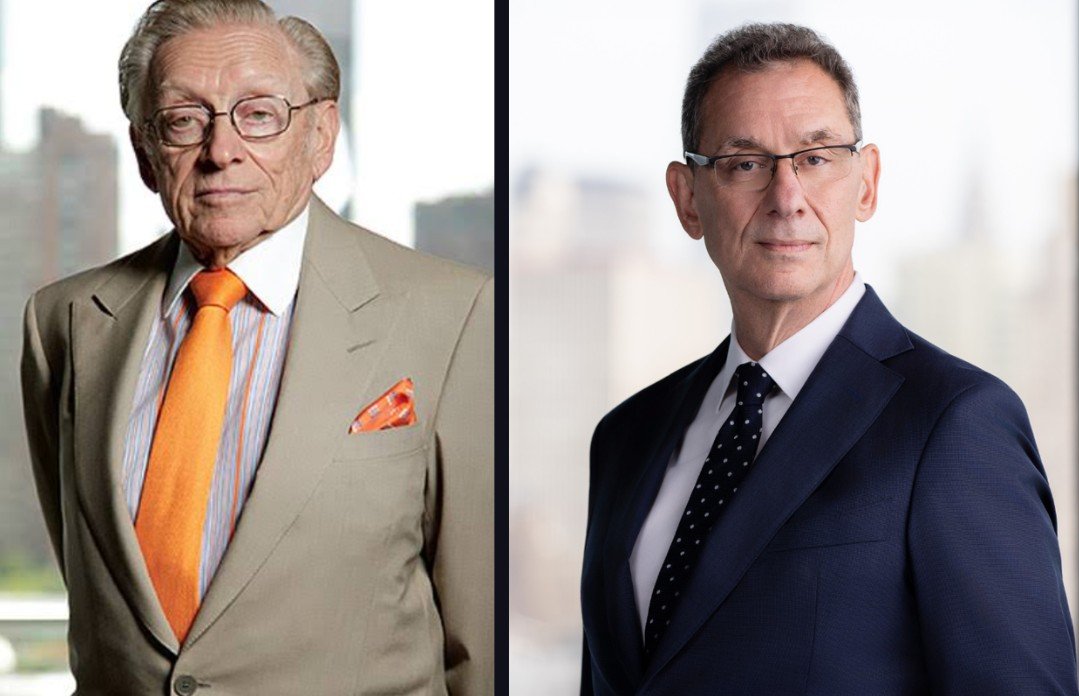
Larry Silverstein and Albert Bourla are two names that appear together in search results for a very specific reason. Both are prominent American business leaders. Both have Jewish heritage that deeply shaped their personal values and professional outlook. And both received recognition at the same high-profile event in 2022 the America-Israel Friendship League Gala, where Silverstein Properties and Pfizer were separately honoured for their contributions to US-Israel relations. Beyond that one occasion, however, their careers run in entirely different directions. Larry Silverstein built his legacy in the concrete and steel world of New York real estate. Albert Bourla built his in global pharmaceuticals. Each of them changed their industry in ways that most executives never come close to achieving.
Who Is Larry Silverstein?

Larry Silverstein was born on May 30, 1931, in Brooklyn, New York. He grew up in a Jewish family and attended the High School of Music and Art in New York City, where his early passion was classical music and the piano. He later graduated with a Bachelor of Arts from New York University in 1952 and also attended Brooklyn Law School.
His path into real estate began alongside his father Harry Silverstein and his brother-in-law Bernard Mendik. In 1957, he officially founded Silverstein Properties. Over the following decades, the company grew steadily, buying and managing office buildings across Midtown and Lower Manhattan. By the 1980s, Silverstein Properties had established itself as one of the serious players in New York commercial real estate not the flashiest name in the room, but reliable, well-run, and deeply rooted in the city.
Then came the moment that defined everything.
The World Trade Center Lease Six Weeks Before 9/11
In July 2001, Larry Silverstein completed the largest real estate transaction in the history of New York City. He won a competitive bid from the Port Authority of New York and New Jersey to secure a 99-year lease on the entire World Trade Center complex for $3.25 billion. It was a staggering deal. The signing happened just six weeks before September 11, 2001.
When the towers came down on that Tuesday morning, Silverstein lost not only the buildings he had just leased but also four colleagues who were at the site for a routine meeting. By his own account, he only avoided being there himself because his wife insisted he keep a dermatologist appointment that morning.
What happened next says everything about the man. While others in his position might have walked away from the ruins and the litigation and the grief, Silverstein did the opposite. He declared publicly and without hesitation that he would rebuild. He meant it.
Rebuilding Lower Manhattan A 25-Year Mission
The road back was brutal. Silverstein spent years locked in complex insurance battles, eventually securing a settlement of $4.55 billion. He navigated disputes with the Port Authority, arguments with architects, political pressure from city and state governments, and a global financial crisis that froze construction financing. Through all of it, he kept building.
7 World Trade Center opened in 2006 the first new tower to rise from the site. 4 World Trade Center followed. 3 World Trade Center came next. Each building represented not just a commercial asset but a signal to the city and to the world that Lower Manhattan was back.
In 2026, the final piece of that vision came together. Silverstein Properties announced that construction was moving forward on 2 World Trade Center, a 55-story tower designed by Foster and Partners that will serve as the global headquarters for American Express. Up to 10,000 employees will eventually work in the building, which is expected to be completed around 2031. That tower will close out the original master plan for the site a plan that Larry Silverstein committed to on the worst day of his life and spent the next 25 years delivering.
September 2026 also marked the 25th anniversary of the 9/11 attacks. Media coverage brought Silverstein back into the spotlight. At 95 years old, he reflected on a vow he made in the rubble of Lower Manhattan and kept every single day since. His daughter Lisa Silverstein now leads the day-to-day operations of Silverstein Properties, but Larry remains its chairman emeritus and its living symbol of what commitment actually looks like when tested by catastrophe.
Larry Silverstein Personal Life and Philanthropy
In 1956, Larry married Klara Silverstein. The couple has three children Sharon, Lisa, and Roger. The family has been active in New York philanthropy for decades, supporting education, medical research, and cultural institutions including NYU School of Medicine, Hunter College, and the Museum of Jewish Heritage.
His net worth is estimated at between one billion and four billion dollars, depending on how real estate assets are valued at any given time. That fortune was built entirely through the development and management of commercial property, not through speculation or financial engineering. It is old-fashioned real estate wealth built over seven decades of work.
Who Is Albert Bourla?

Albert Bourla was born on October 21, 1961, in Thessaloniki, Greece. His background is a story that carries real weight. He grew up in the historic Sephardic Jewish community of Thessaloniki a community that was almost entirely destroyed during the Holocaust. His parents were among a tiny fraction of Thessaloniki’s Jewish population who survived. That history is not a background detail for Bourla. It shapes how he thinks about urgency, responsibility, and what science can mean for human survival.
He studied at the Aristotle University of Thessaloniki, earning a Doctor of Veterinary Medicine degree and later completing his PhD in Biotechnology of Reproduction in 1991. The veterinary path is not what most people expect from a pharmaceutical CEO, but it turned out to be excellent preparation for understanding biology, drug development, and animal and human health systems at a deep level.
Joining Pfizer and Rising Through the Ranks
Bourla joined Pfizer in 1993 as the Technical Director of the company’s Animal Health division in Greece. What followed was an unusually mobile career. Over the next 25 years, he lived in nine different countries and managed operations across five continents. Each posting gave him a different perspective on how global healthcare markets work, what patients need in different regulatory environments, and how multinational companies actually function when you get past the headquarters.
He became Chief Operating Officer in 2018. On January 1, 2019, he took over as Chief Executive Officer of Pfizer. A year later, the COVID-19 pandemic began.
The COVID-19 Vaccine Bourla’s Defining Moment
What Albert Bourla did during the pandemic is genuinely remarkable, and it deserves to be understood clearly rather than reduced to headlines. When COVID-19 began spreading in early 2020, the pressure on pharmaceutical companies was immense. Governments around the world were offering funding to accelerate vaccine development. Most companies took the money. Bourla made a different call.
He declined US government funding for the initial research phase at Pfizer. His reasoning was straightforward taking government money meant accepting government oversight, which meant accepting the bureaucratic slowdowns that come with that oversight. Instead, he committed Pfizer’s own resources, putting billions of company dollars at risk with no guarantee of success.
Working with BioNTech, the German biotechnology company that had been developing mRNA technology for years, Pfizer produced a COVID-19 vaccine in eight months. That is an achievement that most scientists thought was impossible. Vaccine development typically takes a decade or more. The Pfizer-BioNTech vaccine did not cut corners on safety it went through the same clinical trial phases as any other vaccine, just compressed into a fraction of the normal timeframe.
The vaccine was followed by Paxlovid, the first FDA-authorised oral antiviral treatment for COVID-19. Taken together, those two products represent a contribution to public health that is difficult to overstate.
Albert Bourla’s Leadership at Pfizer in 2026
The years following the pandemic peak have been challenging for Pfizer commercially. COVID vaccine and antiviral revenues dropped significantly as the acute phase of the pandemic ended. Bourla has been managing what the pharmaceutical industry calls a patent cliff a period when major drugs lose patent protection and face generic competition, cutting into revenue.
His response has been aggressive acquisition. Pfizer has spent roughly $80 billion on acquisitions since the pandemic, including the major Seagen oncology deal and metabolic disease assets acquired through Metsera. Those investments are aimed at building a pipeline that generates long-term revenue independent of any single product.
By 2026, Pfizer’s new product launches were running at an annualized revenue pace of $15 to $16 billion, and the company had achieved over $7 billion in net cost reductions. Bourla has also been pushing hard on artificial intelligence integration using AI to accelerate drug discovery, reduce clinical trial costs, and improve how the company identifies which molecules are worth pursuing.
He has spoken publicly about his view that China will become Pfizer’s most significant competitor by 2030. That is a striking prediction from a sitting CEO of a Western pharmaceutical giant, and it reflects the kind of honest, forward-thinking assessment that has characterised Bourla’s public communications throughout his leadership.
What Connected Larry Silverstein and Albert Bourla
Their paths crossed publicly in 2022 at the America-Israel Friendship League Gala in New York. Pfizer, with Bourla named directly as a recipient, accepted the Kenneth J. Bialkin Leadership Award for the company’s work in fostering economic and business ties between the United States and Israel. At the same event, representatives of Silverstein Properties including Lisa Silverstein and executive Tal Kerret accepted the Partners for Democracy Award.
Both men also share a heritage rooted in Jewish identity and a family history that includes the shadow of the Holocaust. For Bourla, that heritage is direct his parents were Holocaust survivors from Thessaloniki. For Silverstein, it shaped a broader commitment to Jewish causes, education, and the Museum of Jewish Heritage in New York. That shared background, combined with their prominence in American business, creates natural overlap in certain philanthropic and civic circles even when their professional work does not intersect.
Beyond those points of contact, however, Larry Silverstein and Albert Bourla operate in completely separate worlds. One builds towers. The other builds drugs. Both do it at the very highest level.
Two Different Definitions of Resilience
What makes Larry Silverstein and Albert Bourla worth discussing together is what their stories reveal about how resilience actually works in practice.
Silverstein faced the destruction of everything he had spent his career building, watched 2,977 people die on a site he had just signed the lease for, and then spent 25 years rebuilding it brick by brick. He did not do it because anyone forced him. He did it because he said he would. In 2026, at 95 years old, he is watching the final tower in that plan break ground. That is what commitment over a lifetime looks like.
Bourla grew up with the story of an entire community almost wiped out by genocide. He chose a career in medicine, rose to the top of one of the world’s largest pharmaceutical companies, and then made the decisions during COVID-19 that brought a vaccine to the world faster than it had ever been done before. He took the financial risk personally. He made the call that others would not.
Both men faced moments where the easier path was obvious and the harder path was right. Both chose the harder path.
Quick Facts Larry Silverstein and Albert Bourla
| Detail | Larry Silverstein | Albert Bourla |
|---|---|---|
| Born | May 30, 1931 | October 21, 1961 |
| Birthplace | Brooklyn, New York, USA | Thessaloniki, Greece |
| Field | Real Estate Development | Pharmaceuticals |
| Company | Silverstein Properties | Pfizer |
| Role | Founder and Chairman Emeritus | Chairman and CEO |
| Education | NYU (BA), Brooklyn Law School | Aristotle University (DVM, PhD) |
| Defining Moment | Rebuilding World Trade Center after 9/11 | COVID-19 vaccine in 8 months |
| Net Worth | $1–4 billion | $13 million+ (documented stock holdings) |
| Shared Connection | America-Israel Friendship League Gala 2022 | Same event |
| 2026 News | 2 WTC construction begins final tower | AI integration, patent cliff strategy |
Final Thoughts
Larry Silverstein and Albert Bourla are two people who reached the top of their fields through decades of serious work and made decisions under extraordinary pressure that most people would not have the nerve to make. Silverstein rebuilt the most famous site in American history when he could have walked away. Bourla delivered a COVID vaccine in eight months when the scientific consensus said it could not be done.
They are not business partners. They are not personal friends in any documented sense. However, they are both examples of what it looks like when someone in a position of enormous responsibility decides that the difficult thing is the right thing and does it anyway. For that reason, both names deserve to be understood clearly and accurately not as part of a conspiracy theory or a clickbait comparison, but as two remarkable individuals who built their legacies the hard way.
